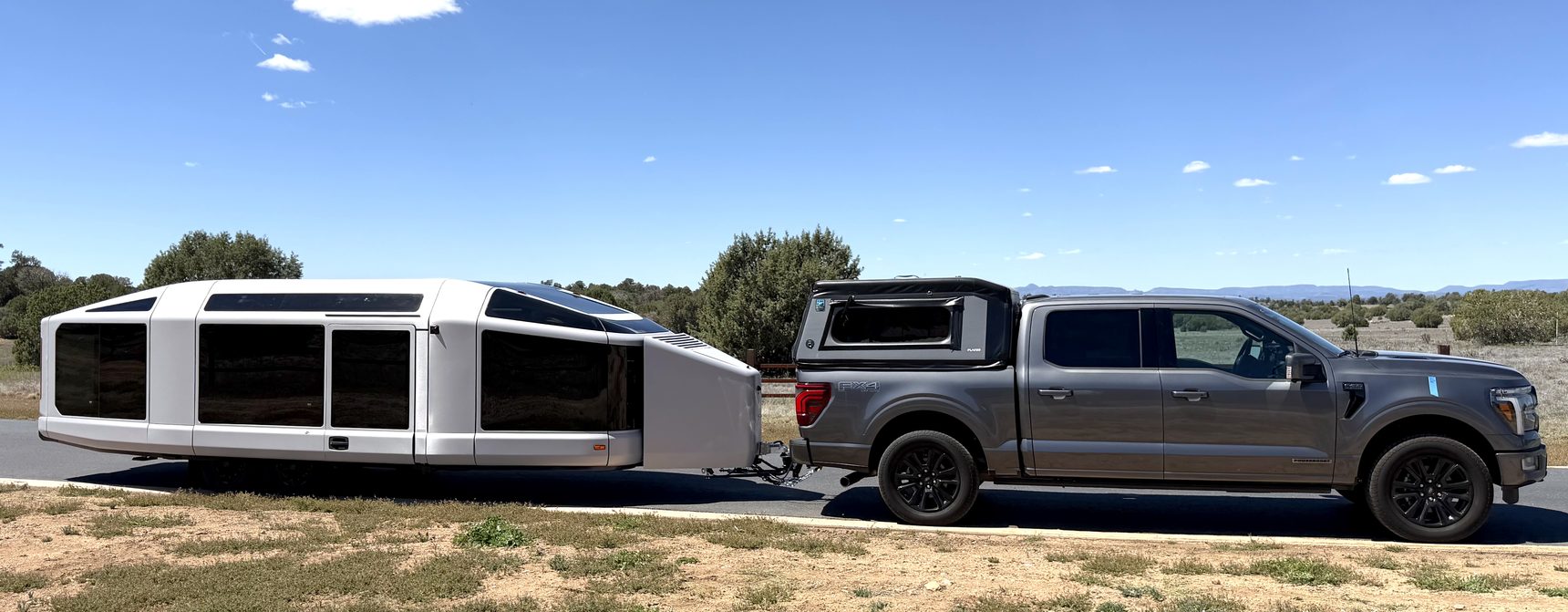
Why does the Turbo Edition have an aluminum wrap versus the standard black trim canopy?
The Question, Stated Honestly
The standard AE.1 carries a black trim canopy. The Turbo Edition carries an aluminum wrap over the same structure. The two look different, and if the answer stopped there it would belong to the marketing department rather than this site.
It does not stop there. The canopy is a large, essentially horizontal, sun-facing surface sitting directly over the living volume and adjacent to the solar array. Of every surface on the trailer, it receives the highest annual solar load per square meter and it does so overwhelmingly while the trailer is stationary. That combination — horizontal, high insolation, parked — is the narrow set of conditions under which the color of an exterior finish still meaningfully changes an energy number rather than just an appearance.
Trim configuration (standard = black canopy, Turbo Edition = aluminum wrap) is stated by the operator, not verified here against a LightShip production spec sheet. If the standard trim is a different value than assumed, the shape of the argument holds and only the magnitude of the delta moves.
What the Film Maker Publishes: Nothing
The obvious first move is to look up the numbers. There are none.
3M's product bulletins for Wrap Film Series 2080 — the cast film series used for automotive and trailer wraps — carry adhesion values, thickness, conformability notes, roll widths, and warranty terms. They carry no total solar reflectance, no solar absorptance, and no per-color thermal data of any kind. 3M publishes TSR figures for its architectural and window film lines, where thermal performance is the product claim. For opaque vehicle wrap, it does not.
The only thermal figure anywhere in the 2080 documentation set is a damage limit: the film surface must not be allowed to exceed +107 °C (225 °F) or the film may burn. That appears in the maintenance FAQ as a heat-gun caution during scratch removal. It is a destruction threshold, not a performance specification — but it becomes relevant again in section 07.
There is no manufacturer thermal data for this film in any color. Every absorptance value in this article is transferred from automotive paint and cool-roof literature on the argument in section 03. That transfer is defensible, and it is still a transfer. Nothing here is a measurement of a 2080 film.
Why Paint Data Transfers to Vinyl
2080 is a 3.5 mil (~89 µm) opaque cast film. At that thickness and opacity it is optically thick to solar radiation — sunlight does not reach the substrate, it is absorbed or reflected inside the film's own pigment layer. The film therefore behaves as a surface optical layer in exactly the way a paint topcoat does, and its solar absorptance is set by pigment chemistry rather than by the fact that it happens to be adhesive-backed.
Two consequences follow, and both are worth stating because both are commonly gotten wrong:
- Long-wave emissivity is effectively constant across colors. Pigmented polymer surfaces sit around ε ≈ 0.90–0.95 regardless of what color they look like to the eye. Color moves absorptance α only. Since equilibrium temperature is driven by the ratio α/ε, and ε is fixed, α is the whole story.
- Matte and gloss of the same color are thermally near-identical. Finish changes the direction of reflected light, not the fraction absorbed, and it does not change ε. The widely repeated claim that matte black runs hotter than gloss black does not survive the physics.
Mirror-chrome and heavily metallized films are the one case where this reasoning can fail. A bare metallic surface has depressed emissivity, and a surface with low ε runs hot for its reflectance because it cannot radiate the absorbed fraction away. 2080's metallized finishes carry a clear polymer topcoat that should restore most of the emissivity, but no published ε exists for them. An aluminum-look pigmented film and a true mirror-chrome film are not interchangeable in this argument. The Turbo Edition specification should name a brushed/satin aluminum finish rather than a mirror chrome, and the distinction should not be treated as cosmetic.
Absorptance by Finish Family
The anchor for the transferred values is Lawrence Berkeley National Laboratory's instrumented two-vehicle study, which measured shell solar reflectance of 0.05 for black and 0.58 for silver on otherwise identical cars. The families below bracket that anchor.
| Finish family | Reflectance ρ | Absorptance α | Basis |
|---|---|---|---|
| Gloss / satin white | 0.72–0.80 | 0.20–0.28 | cool-roof standard white anchor |
| Aluminum / silver metallic | 0.50–0.58 | 0.42–0.50 | LBNL silver shell, ρ = 0.58 |
| Light gray, beige, sand | 0.40–0.50 | 0.50–0.60 | interpolated |
| Saturated red / blue / green | 0.12–0.28 | 0.72–0.88 | paint literature range |
| Charcoal, dark gray | 0.08–0.14 | 0.86–0.92 | interpolated |
| Black (gloss or matte) | 0.04–0.06 | 0.94–0.96 | LBNL black shell, ρ = 0.05 |
The working comparison for this article is therefore α ≈ 0.46 (aluminum) against α ≈ 0.95 (black) — roughly a factor of two in absorbed solar flux, on the same panel, under the same sun.
The Split That Decides It: Parked vs. In Motion
Absorbed flux is only half the equation. Steady-state skin temperature rise above ambient is governed by how fast that absorbed energy leaves again:
ΔT ≈ α · G / htotal
Stated assumptions: G = 950 W/m² near-normal midday summer insolation. htotal = 20 W/m²·K parked (natural convection plus linearized radiation on a horizontal surface). htotal = 74 W/m²·K at 62 mph (turbulent flat-plate forced convection, characteristic length 3 m, plus radiation). Both h values are engineering estimates, not measurements on this trailer; substrate conduction is neglected, which biases the parked figures slightly high.
The forced-convection term is the entire argument. Moving at highway speed multiplies the heat-removal coefficient by roughly 3.7×, which divides the color effect by the same factor.
| Finish | α | Parked | 62 mph |
|---|---|---|---|
| White | 0.24 | 11 °C / 21 °F | 3 °C / 6 °F |
| Aluminum | 0.46 | 22 °C / 39 °F | 6 °C / 11 °F |
| Saturated color | 0.80 | 38 °C / 68 °F | 10 °C / 18 °F |
| Black | 0.95 | 45 °C / 81 °F | 12 °C / 22 °F |
| Aluminum vs. black delta | — | 23 °C / 42 °F | 6 °C / 11 °F |
The modeled parked delta lands almost exactly on LBNL's instrumented result. In their soak trials the roof of the silver car peaked as much as 25 °C (45 °F) cooler than the roof of the identical black car. The model above predicts 23 °C / 42 °F for the same pairing without being fitted to it. That is corroboration of the parked case by an independent measurement on a different vehicle.
Superseded on this rig. The aluminum-vs-black parked row of Table 2 has since been measured directly on the LightShip canopy — 50 °F / 27.8 °C, against the 42 °F / 23 °C modeled here. See section 09. The modeled row is retained as written so the prediction can be read against the result rather than quietly replaced by it.
The parked-to-moving collapse is the finding. A finish decision that is worth 42 °F of skin temperature at a campsite is worth about 11 °F at 62 mph. Any argument for the aluminum wrap has to be made in the parked domain, because that is where the effect lives.
Why That Suits a Turbo Edition Specifically
This is where the wrap stops being a general RV observation and becomes a Turbo Edition observation.
The entire premise of the Turbo Edition is that the PowerBoost fills the trailer battery while the rig is moving, so that the customer arrives with stored energy and spends it while parked. The product's value is realized at the campsite, in the overnight and midday hours when the trailer is stationary, the sun is on the roof, and the HVAC compressor is the largest single consumer of the energy that was so expensively hauled there. Campaign 1 documented overnight lived-in draw at 1–2+ kWh/hr for HVAC alone.
A finish that reduces solar gain only while parked is therefore perfectly matched to a product whose whole economic argument is about parked energy. The wrap does not help the truck, does not help the tow, and does not need to. It reduces the load on the exact kilowatt-hours the Turbo Edition exists to deliver.
The order of magnitude, honestly bounded
Conductive gain through the canopy scales with the temperature difference across the insulation. Taking a nominal 12 m² canopy area at an assumed U ≈ 0.44 W/m²·K (roughly R-13 US), a 23 °C lower skin temperature avoids on the order of 120 W of conductive gain, or roughly 40 W of compressor electrical draw at COP 3 — about 0.4 kWh across a ten-hour midday period.
LightShip has not published the canopy area or its R-value. Both figures above are placeholders chosen to establish scale, not to be quoted. The direction is certain; the magnitude is not. If the canopy section has a lower effective R than the main shell — which is common for a deployable roof structure — the same skin delta produces a proportionally larger saving, and the estimate above is conservative.
LBNL's headline result — that the silver car required 13% less A/C capacity than the black car — must not be carried across to the AE.1. That vehicle's cabin gain is dominated by glass, and a car's glazing fraction is nothing like an insulated trailer's. The AE.1 figure will be materially smaller. Quoting 13% in a Turbo Edition context would be a category error, and it is the single most likely way this analysis gets misused.
Second-order: the solar array
Photovoltaic output falls roughly 0.35–0.45 %/°C above 25 °C cell temperature, so a cooler canopy structure adjacent to and beneath the 1.8 kW array should raise array yield slightly. But the cells themselves are dark regardless of trim color, mounting standoff and airflow dominate cell temperature, and no measurement of array temperature exists on this rig. This is recorded as a plausible secondary benefit with an unknown magnitude. It is not part of the case.
Durability and Warranty: the Second Reason
The thermal argument has a durability twin that requires no modeling at all, only arithmetic against a published limit.
On a 38 °C (100 °F) Arizona afternoon, the modeled black skin lands near 83 °C; the aluminum skin lands near 60 °C. 3M's stated burn threshold for 2080 is 107 °C. Black therefore operates with roughly 24 °C of margin to film damage on a routine hot day; aluminum operates with roughly 47 °C. Neither is failing, but one is spending its service life much closer to the limit, and thermal cycling amplitude is what drives adhesive creep, edge lift, and dimensional stability loss in cast vinyl.
The warranty terms point the same direction. 3M's MCS warranty on 2080 offers up to eight years on vertical applications. Horizontal surfaces are the derated case precisely because they collect the solar load quantified above. A canopy is horizontal by definition. Specifying the darkest available finish for the single most horizontal panel on the vehicle is the worst combination of thermal load and warranty exposure available.
- Lower peak skin temperature → larger margin to the 107 °C film limit.
- Lower thermal cycling amplitude → less adhesive creep and edge lift over the warranty period.
- Horizontal orientation is already the derated warranty case; a low-α finish partially offsets what the orientation costs.
What This Article Does Not Claim
Four claims are available here and would be wrong. Naming them is part of the answer.
- It is not an aerodynamic claim. Finish color has no bearing on Cd·A. The combined-rig drag figure remains unmeasured and is the Campaign 2 priority; the wrap contributes nothing to it in either direction.
- It is not a tow-vehicle engine-thermal claim. Campaign 1's worst thermal event was 241.2 °F ECT at 78.8 °F ambient on a 7,500–8,200 ft grade — an altitude-and-load event. Trailer skin absorptance contributes single-digit °F to a boundary layer that never reaches the intercooler in any meaningful way. No wrap decision should be argued on engine-thermal grounds.
- It is not a fuel-economy claim. The in-motion delta is ~11 °F of skin temperature on an insulated trailer. Any resulting fuel effect is far below the resolution of the instrumentation and is not reported.
- Only one quantity here is measured. Canopy skin temperature (section 09) was measured on this trailer. Everything else — absorptance values, heat-transfer coefficients, the conductive-gain and HVAC estimates in section 06, and the in-motion column of Table 2 — remains transferred or modeled. A measured skin temperature is not a measured energy saving, and the two are not interchangeable.
Closing It: the Measurement, Run
The measurement proposed in the draft of this article has been taken. It confirms the direction of the argument, exceeds the modeled magnitude by about 16%, and leaves the energy claim in section 06 exactly where it was — modeled.
Infrared thermometer, LightShip canopy, same canopy location for both finishes. Ambient 100 °F.
| Finish | Skin temp | ΔT above ambient | Model predicted | Model error |
|---|---|---|---|---|
| Black canopy paint | 195 °F / 90.6 °C | 95 °F / 52.8 °C | 81 °F | −15% |
| 3M 2080 aluminum wrap | 145 °F / 62.8 °C | 45 °F / 25.0 °C | 39 °F | −13% |
| Delta, aluminum vs. black | 50 °F / 27.8 °C | 50 °F / 27.8 °C | 42 °F | −16% |
What the result validates
The model under-predicted both surfaces by a nearly identical fraction — 15% and 13% — which is the signature of a stated assumption being slightly off rather than the physics being wrong. Backing the assumptions out of the measurement gives G / htotal ≈ 55.6 from the black reading and 54.3 from the aluminum reading, agreeing within 2.4%. That is consistent with insolation nearer 1,050–1,100 W/m² rather than the assumed 950 (August 1, solar noon, clear sky, horizontal surface, at elevation), and with a slightly calmer htotal near 18 rather than 20. Both corrections push the same direction and together close the gap.
The measured ΔT ratio between the two finishes is 95 / 45 = 2.11. The absorptance ratio assumed in Table 1 is 0.95 / 0.46 = 2.07. Those agree to within 2%.
This matters more than the absolute temperatures, because it is independent of both G and h — the unknowns cancel. It confirms two things the article asserted on borrowed data: that the transferred absorptance values in Table 1 are approximately right for these two finishes, and that long-wave emissivity is not materially different between them (section 03). Had the aluminum wrap carried a depressed ε, the ratio would have come apart. It did not.
What the result does not establish
- It is a skin temperature, not an energy saving. Section 06's conductive-gain estimate re-anchored on the measured 27.8 °C delta rises from ~120 W to ~147 W, or roughly 0.5 kWh of compressor draw over a ten-hour midday period — but it still rests on an unverified canopy area and an unverified R-value, and it remains modeled. Do not quote it as a measured saving.
- n = 1. One day, one time of day, one panel pair, no repeat and no second insolation point. The proposed protocol's second reading at a different time of day was not taken.
- Insolation was not measured. No pyranometer, so G is inferred from the temperatures rather than known independently. The energy balance in this section is closed on an assumption, not on two independent instruments.
- The comparison is finish-as-installed, not color-isolated. Black paint versus aluminum film differ in material as well as color. That is the correct comparison for the product question — it is what a buyer actually chooses between — but it is not a controlled single-variable test of color.
An infrared thermometer computes temperature from an assumed emissivity setting. If the gun was left at a typical 0.95 default and the aluminum wrap's true ε is lower, the aluminum reading is biased low and the real delta is smaller than 50 °F. The 2% ratio agreement above argues against a large mismatch, but it does not exclude a modest one, and it is the one assumption in this measurement that could move the headline number.
Cheap close-out: re-read the aluminum surface with a strip of high-emissivity tape applied to it, or place a contact thermocouple alongside the IR spot. Five minutes, and it converts the delta from "measured with one assumption" to measured.
Also record: whether the two readings were taken on the same physical panel and substrate or on two trailers, and the site elevation — both bear on the G back-out above and neither is captured in the reading as logged.
Where the case now stands
The answer to the title question is no longer entirely borrowed. On a 100 °F clear August noon, the standard black canopy runs at 195 °F and the aluminum-wrapped canopy at 145 °F at the same location — a measured 50 °F difference on the trailer's largest, most horizontal, most sun-exposed panel, in precisely the parked condition where the Turbo Edition spends the energy it was built to deliver. The physics behind that number checks out to within 2% on the one test that is free of assumptions.
What remains modeled is the conversion of that 50 °F into kilowatt-hours: the canopy area, its R-value, and the HVAC coefficient of performance are all still assumed. The wrap is specified because the canopy is the highest-solar-load horizontal surface on the trailer, because finish color retains real authority parked and loses most of it in motion, and because the darkest finish on the most horizontal panel is also the worst case for film life and warranty. The first of those is now measured. The rest is reasoning, and this document continues to say which is which.
Mass basis measured — CAT scale + verified payload, 15,320 lb / 6,949 kg.
External sources: 3M Wrap Film Series 2080 product bulletin and wrapped-vehicle maintenance FAQ (no thermal performance data published); Lawrence Berkeley National Laboratory cool-colors vehicle study (shell reflectance 0.05 black / 0.58 silver; roof peak delta to 25 °C).
Measured values green, modeled amber, flags rust, observations neutral — modeled numbers are never presented as measurements.
Design-rationale document · drafted 2026-08-01, amended same day with the section 09 canopy skin-temperature measurement.
Measurement of record: IR thermometer, LightShip canopy, solar noon, clear, OAT 100 °F — black paint 195 °F, 3M 2080 aluminum 145 °F. n = 1; instrument emissivity setting unconfirmed.